
An engineering research team from the HKU CANLab, the Department of Electrical and Electronic Engineering (EEE) at The University of Hong Kong (HKU), led by Professor Can LI, Dr. Guoyun GAO and Mr. Bo WEN, has developed a breakthrough in 2D materials for efficient edge AI, sb-contacted MoS2 flash memory enables ultra-efficient in-memory computing in analogue content addressable memory. The research paper has been published in Nature Nanotechnology, titled “Sb-contacted MoS2 flash memory for analogue in-memory searches”.
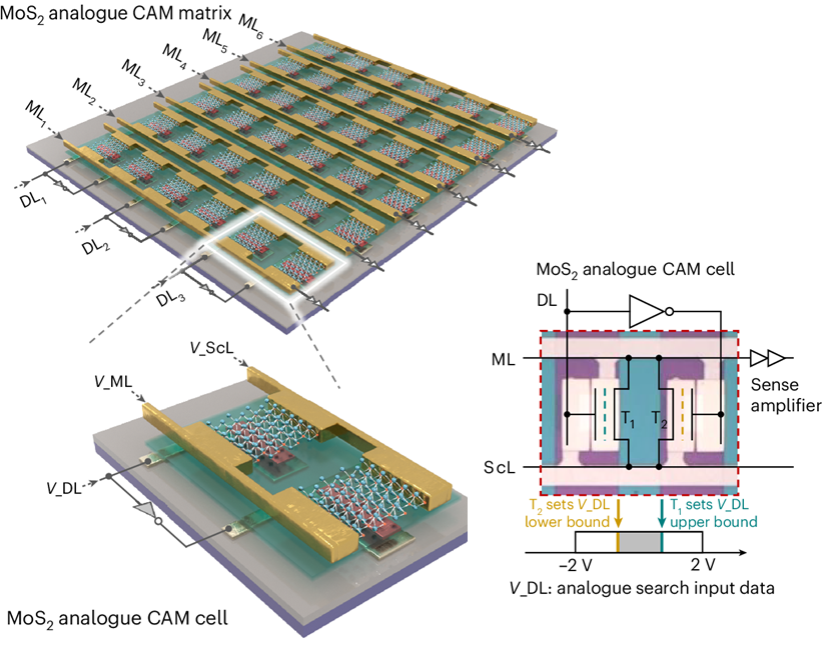
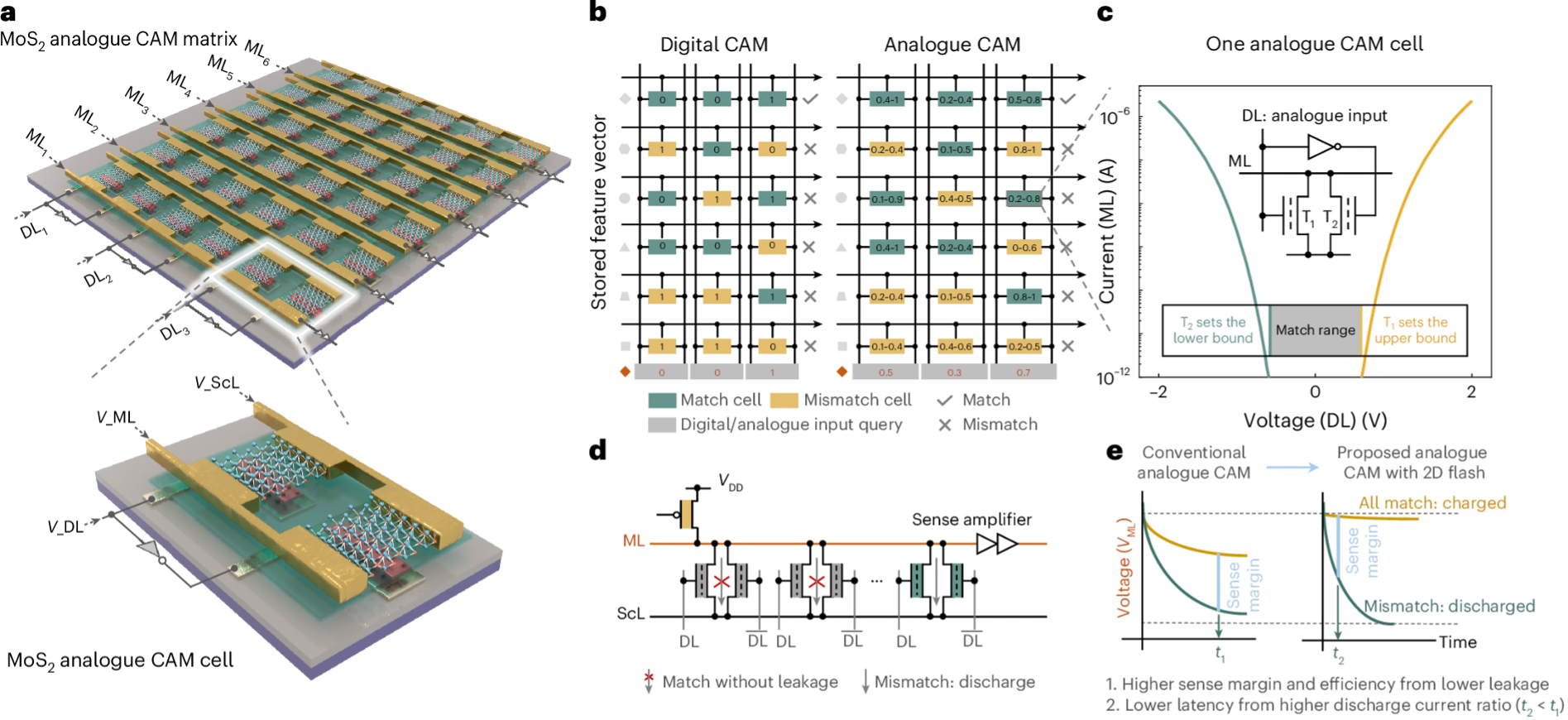
This work introduces an analogue content-addressable memory based on atomically thin MoS2 flash array with semimetal antimony (Sb) contacts. The innovation delivers record-high performance, including ultra-low energy consumption (<0.1 fJ per search per cell) and ultra-short latency (36 ps), paving the way for scalable, low-power hardware ideal for real-time artificial intelligence at the edge.
The rapid growth of AI and edge devices has highlighted a major bottleneck in conventional computing: slow data shuttling between memory and processors. Content-addressable memories (CAMs) address this by enabling direct in-memory processing, but traditional silicon-based versions are limited by transistor performance.
This work demonstrated a groundbreaking analogue CAM array using 2D MoS2 flash memories with Sb contacts. The fabricated devices achieve:
- Record readout current (60 μA μm-1) and large ON/OFF ratios (>109) in MoS2 flash memory device for improvement of latency, sense margin and power efficiency of analogue CAMs
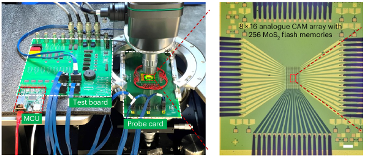
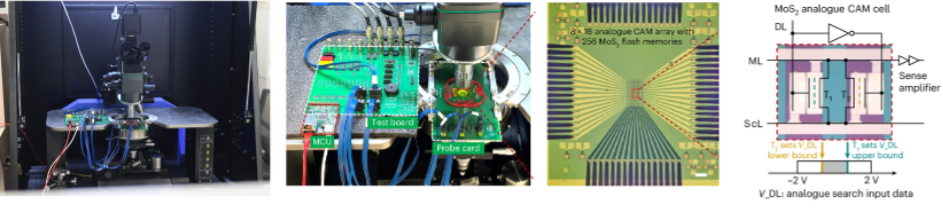
- Experimental analogue in-memory searches in physical 8 × 16 arrays with 256 MoS2 flash memories devices.
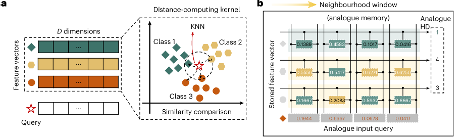
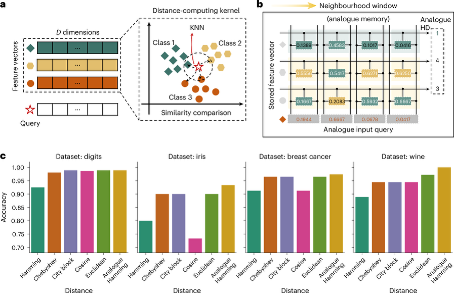
- Successful analogue Hamming distance computation for k-nearest neighbour classification, with high accuracy, energy efficiency, and low latency
This advance underscores the power of 2D materials to surpass silicon limitations, offering transformative potential for efficient, intelligent edge computing.

^From left to right: Prof. Can LI, Dr. Guoyun GAO, Mr. Bo WEN.
Link to the paper: https://www.nature.com/articles/s41565-025-02089-7
Guoyun Gao#, Bo Wen#, Ni Yang, Zhiyuan Du, Mingrui Jiang, Ruibin Mao, Rui Qiu, Yingnan Cao, Hongxia Xue, Deng Zou, Pak San Yip, Qihan Liu, Yi Wan, Dong-Keun Ki, Jinyao Tang, Paddy K. L. Chan, Hao Jiang, Han Wang, Lain-Jong Li* and Can Li*, Sb-contacted MoS2 flash memory for analogue in-memory searches. Nature Nanotechnology. 2025, accepted. DOI:10.1038/s41565-025-02089-7.