
Research Assistant Professor Yanmin ZHU from the Department of Electrical and Electronic Engineering at The University of Hong Kong (HKU), in collaboration with Professor Loza F. TADESSE from the Massachusetts Institute of Technology (MIT), worked on the research for the topic “SpectroGen: A physically informed generative artificial intelligence for accelerated cross-modality spectroscopic materials characterization”. The research findings were published by Matter on October 14, 2025.
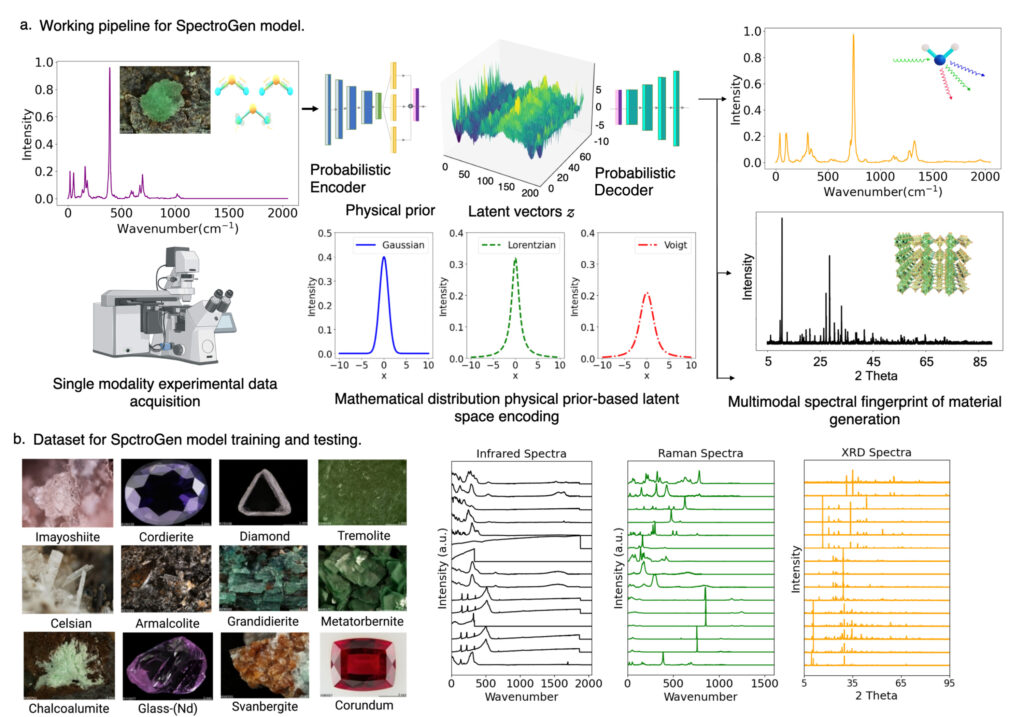
^Figure: SpectroGen workflow.

^Dr. Yanmin ZHU, Research Assistant Professor at the Department of Electrical and Electronic Engineering
Details of the Publication
SpectroGen: A physically informed generative artificial intelligence for accelerated cross-modality spectroscopic materials characterization
Yanmin Zhu, Loza F. Tadesse*
Article in Matter: https://doi.org/10.1016/j.matt.2025.102434
Abstract
Artificial intelligence (AI)-driven materials discovery offers rapid design of novel material compositions, yet synthesis and characterization lag behind. Characterization, in particular, remains bottlenecked by labor-intensive experiments using expert-operated instruments that typically rely on electromagnetic spectroscopy. We introduce SpectroGen, a generative AI model for transmodality spectral generation, designed to accelerate materials characterization. SpectroGen generates high-resolution, high-signal-to-noise ratio spectra with 99% correlation to ground truth and a root-mean-square error of 0.01 a.u. Its performance is driven by two key innovations: (1) a novel distribution-based physical prior and (2) a variational autoencoder (VAE) architecture. The prior simplifies complex structural inputs into interpretable Gaussian or Lorentzian distributions, while the VAE maps them into a physically grounded latent space for accurate spectral transformation. SpectroGen generalizes across spectral domains and promises rapid, accurate spectral predictions, potentially transforming high-throughput discovery in domains such as battery materials, catalysts, superconductors, and pharmaceuticals.