
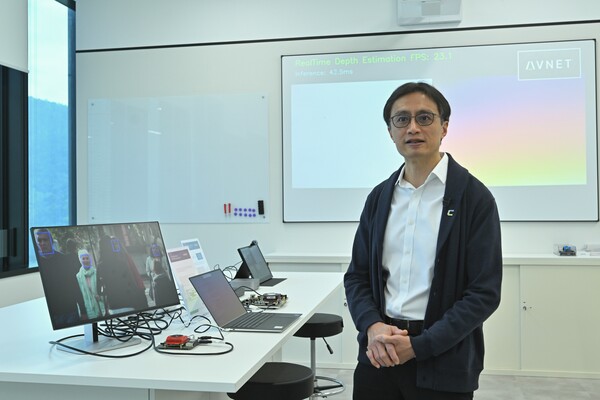
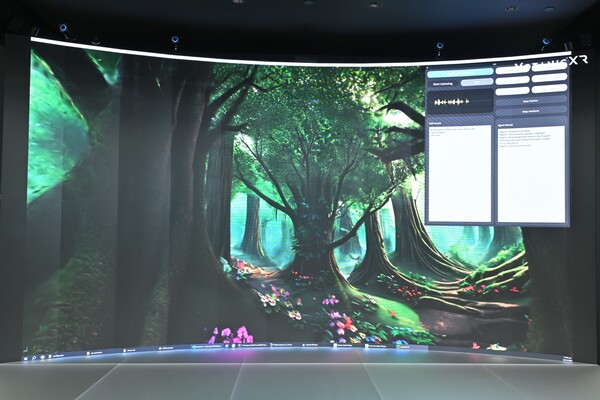
Professor Ngai WONG from the Department of Electrical and Electronic Engineering at The University of Hong Kong recently participated in an interview with the Hong Kong Government’s online news platform (news.gov.hk) to share his and his team’s latest innovations and prospects in intelligent technology. Prof. Wong showcased the groundbreaking technology developed with his team at the Emerging Microelectronics and Ubiquitous Systems Lab (EMUS). This technology enables users to issue voice or text commands to artificial intelligence (AI) to rapidly generate real-time 3D scenes.
For instance, by simply saying, “Create a luxurious hotel with a long corridor, warm golden lighting, elegant wall decorations, and a deep sense of layers”, the system can instantly visualise the scene. This technology is highly applicable across various industries, including presentation, game design, and more. For example, interior designers can simulate furniture arrangements without building physical models, simply through verbal instructions. Similarly, game developers can quickly design adventure or treasure-hunting scenarios set in the Amazon rainforest.
Prof. Wong also discussed the use of generative AI, which can transform abstract concepts or product ideas into visual images, thereby inspiring new markets and innovative concepts. He highlighted that compared to similar foreign technologies, his system’s advantages include not relying on large-scale cloud computing and employing compression techniques, allowing the system to operate on mobile devices such as smartphones, thus broadening its accessibility and application.
- Source (news.gov.hk): https://www.news.gov.hk/eng/2026/01/20260102/20260102_152131_799.html
- About EMUS Lab: https://www.ke.hku.hk/spotlight/emus-lab
(Chinese version)
香港大學電機電子工程系黃毅教授近日接受政府新聞網專訪,分享其和研發團隊在智能科技領域的最新研發成果及應用前景。黃教授介紹了由他與新興微電子與普及計算系統實驗室(EMUS)團隊共同開發的創新技術,該技術能通過語音或文字輸入,向人工智能發出指令,快速生成三維場景。
例如,用戶只需說出「創造一間豪華酒店,內有長長的走廊、溫暖的金黃燈光、典雅的牆壁裝飾,並具有深邃的層次感」,系統便能即時呈現出相應的三維場景。這項技術廣泛應用於行業介紹、遊戲設計等領域,為專業人士提供便捷高效的創作工具。例如,室內設計師可以不用搭建實體模型,只需口述便能模擬家具佈置;而遊戲開發者則能快速設計出亞馬遜雨林探險或尋寶場景。
黃教授亦介紹了生成式人工智能的應用,能將抽象概念或產品構想轉化為影像,從無到有地激發新市場與創新思維。他指出,與國外類似技術相比,該系統的優勢在於不依賴大型雲端運算,並採用壓縮技術,使其能夠在手機等移動裝置上運行,實現更廣泛的普及與應用。
- 來源(政府新聞網) : https://www.news.gov.hk/chi/2026/01/20260102/20260102_152131_799.html
- 關於 EMUS 實驗室:https://www.ke.hku.hk/spotlight/emus-lab