
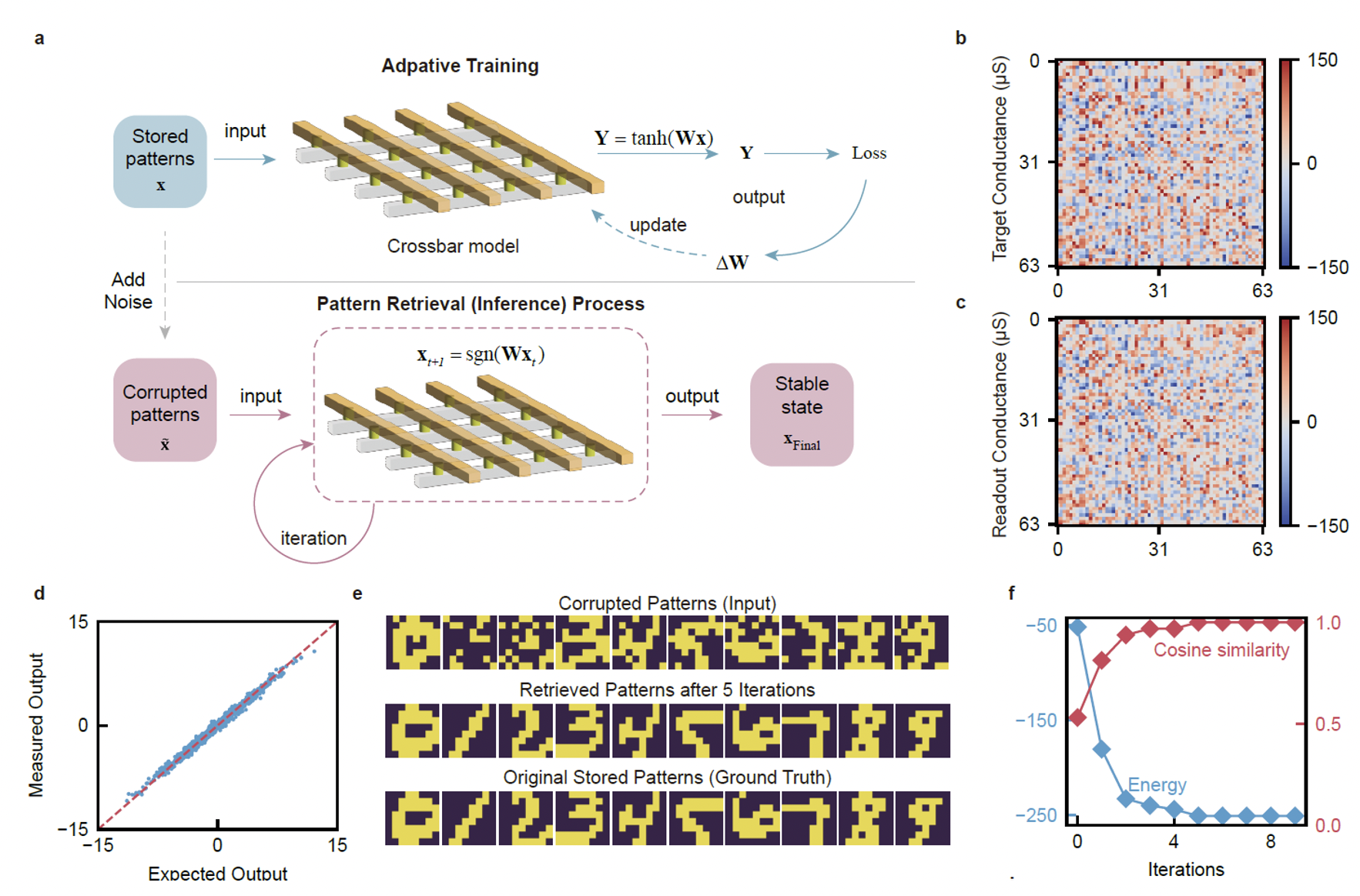
An engineering research team from the HKU CANLab, the Department of Electrical and Computer Engineering (ECE) at The University of Hong Kong (HKU), led by Prof. Can LI and Mr. Chengping HE, in collaboration with Hewlett Packard Labs, has achieved a breakthrough in neuromorphic computing, specifically associative memory implemented in memristor hardware. The team developed a hardware-adaptive learning algorithm on memristor crossbars that successfully overcomes three major bottlenecks for brain-like associative memory: sensitivity to device defects, severely limited storage capacity, and the inability to process continuous-valued data. The research paper has been published in Nature Communications, titled “A hardware-adaptive learning algorithm for superlinear-capacity associative memory on memristor crossbars”.
This work introduces a hardware-adaptive learning algorithm paired with an integrated memristor crossbar compute-in-memory platform. The innovation delivers high defect tolerance and effective storage capacity, paving the way for robust, energy-efficient brain-like associative recall for intelligent edge devices.
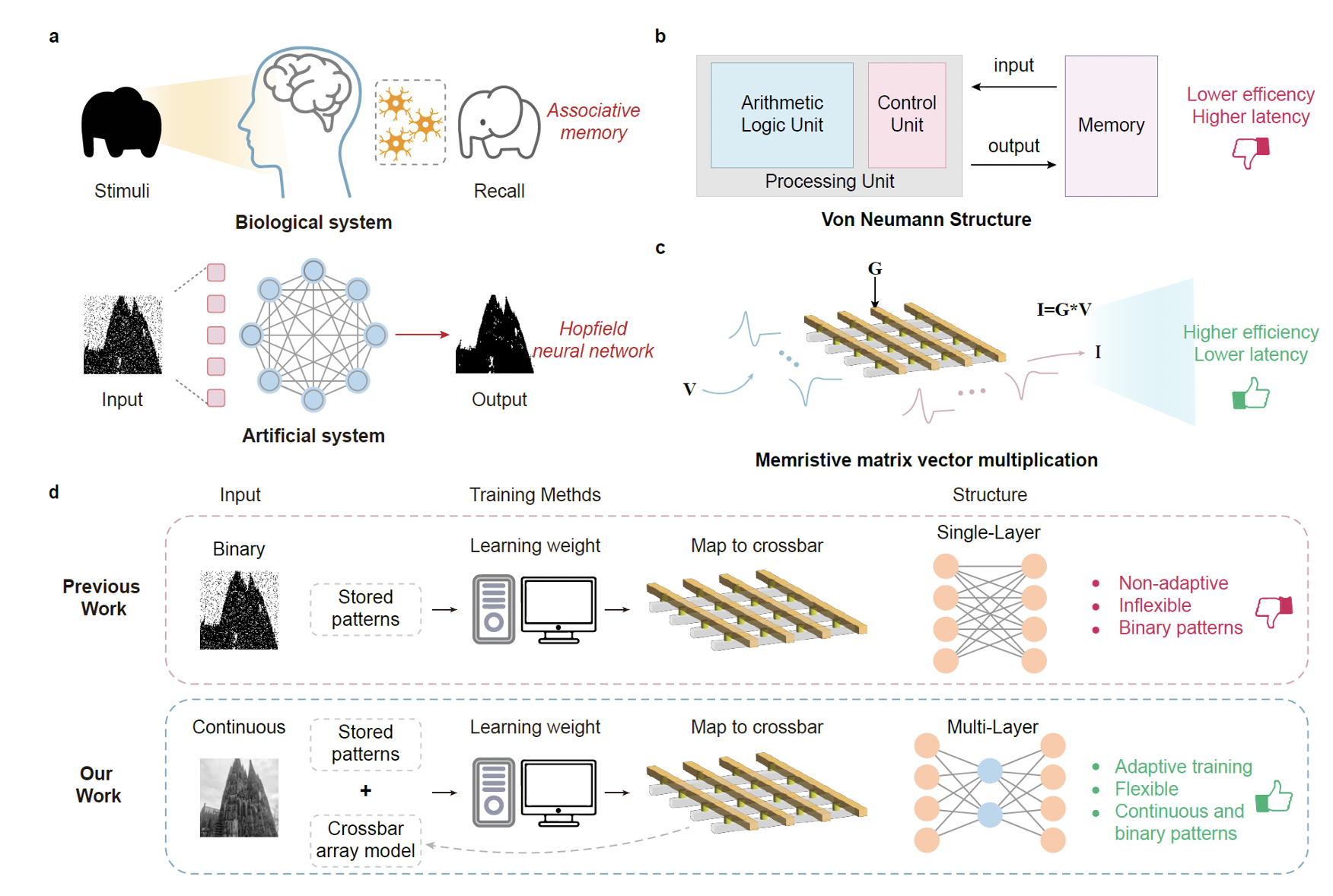
The need for pattern completion and memory recall from partial cues is critical for AI, but conventional von Neumann computing architectures suffer from high latency and low efficiency due to the separation of memory and processors. While standard Content-Addressable Memory (CAM) provides one-shot lookups, it operates differently from the continuous iterative state evolution of true Hopfield dynamics. Previous memristor-based Hopfield implementations attempted to solve this but were heavily limited by vulnerability to device defects, constrained storage capacity, and an inability to process continuous-valued patterns.
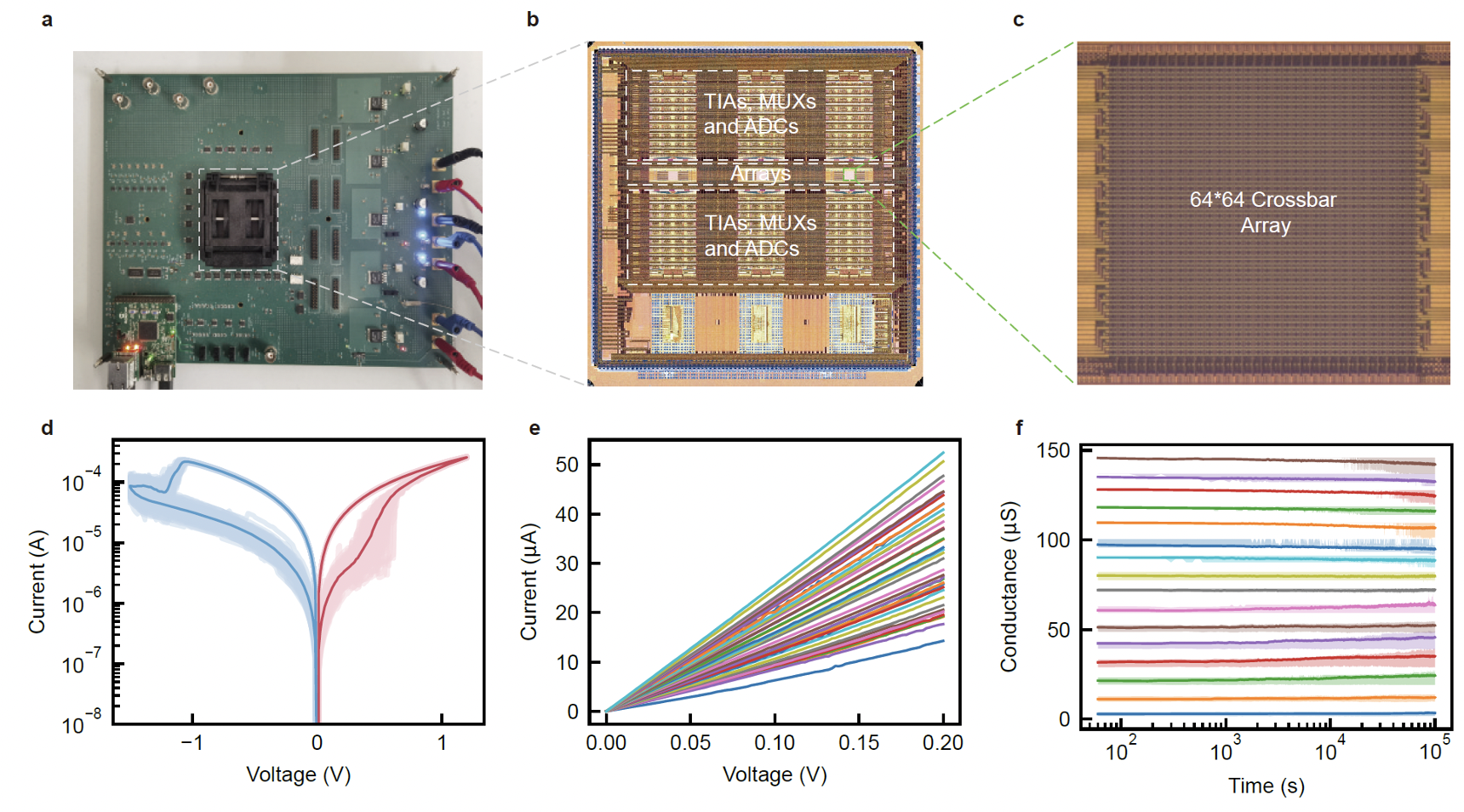
This work demonstrated a groundbreaking analogue true associative memory system using 64×64 RRAM crossbar arrays. The integrated system achieves:
- Exceptional defect tolerance: Maintaining a threefold higher capacity than state-of-the-art baseline algorithms even when 50% of the hardware devices suffer from stuck-at faults.
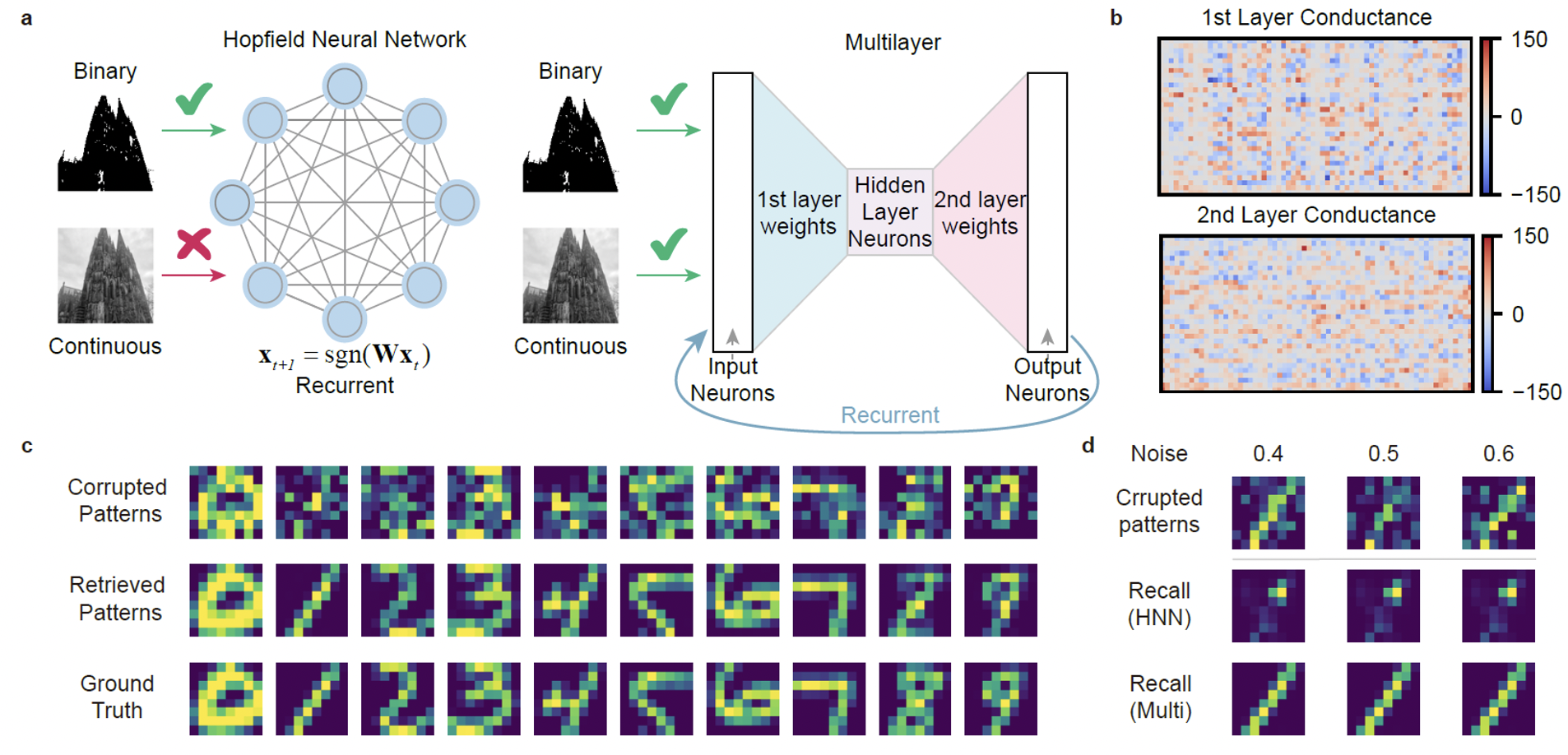
- Superlinear capacity scaling: By extending the framework to scalable multilayer architectures, the system successfully supports both binary and continuous-valued patterns with superlinear scaling on correlated data.
- Ultra-efficient processing: Leveraging crossbar parallelism with synchronous updates, the implementation reduces energy consumption by 8.8x and cuts latency by 99.7% for 64-dimensional patterns compared to previous asynchronous schemes.
This advance underscores the power of co-locating computing and storage in true hardware-based associative memory, surpassing computer-based emulations and offering transformative potential for robust, low-power neuromorphic computing.
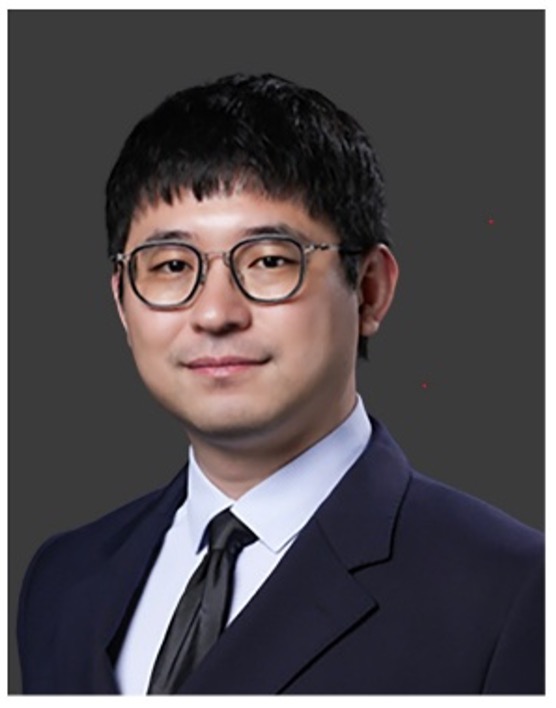
^Prof. Can LI
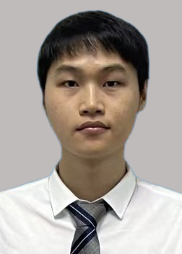
^Mr. Chengping HE
Read more in the paper: https://www.nature.com/articles/s41467-026-69958-0
He, C., Jiang, M., Shan, K., Yang, S. H., Li, Z., Wang, S., … & Li, C. (2026). A hardware-adaptive learning algorithm for superlinear-capacity associative memory on memristor crossbars. Nature Communications.