
Dr. Haichao LEI, Minister of the National Health Commission (NHC) of the People’s Republic of China, led a delegation comprising representatives of the NHC, the Hong Kong and Macao Work Office of the Communist Party of China Central Committee and the Hong Kong and Macao Affairs Office (HKMAO) of the State Council, accompanied by Prof. Chung-mau LO, the Secretary for Health of the Government of the Hong Kong Special Administrative Region, visited The University of Hong Kong (HKU) on 13 January 2026. The delegation met with Dr. Peter WONG, Chairman of the HKU Council; Prof. Xiang ZHANG, HKU President and Vice-Chancellor; Prof. Chak-sing LAU, Vice-President and Pro-Vice-Chancellor (Health); Ms. Isabella WONG, Associate Vice-President (China Affairs); Prof. Kenneth M.C. CHEUNG, Hospital-Chief-Executive of the University of Hong Kong-Shenzhen Hospital and representatives from HKU.
The delegation visited the HKU Biomedical Imaging Laboratory (BISP Lab) at the Department of Electrical and Electronic Engineering. The BISP Lab is an interdisciplinary research hub jointly established by the Department of Electrical and Electronic Engineering and the Li Ka Shing Faculty of Medicine. The laboratory pioneers research examining the relationships between anatomical structures, physiological functions and neural activities in both healthy and diseased states. Led by Professor Ed X. WU, BIPSP Lab focuses on developing advanced imaging technologies and computational methodologies for animal and human studies, while also engineering next-generation MRI solutions to improve precision medicine and healthcare accessibility.
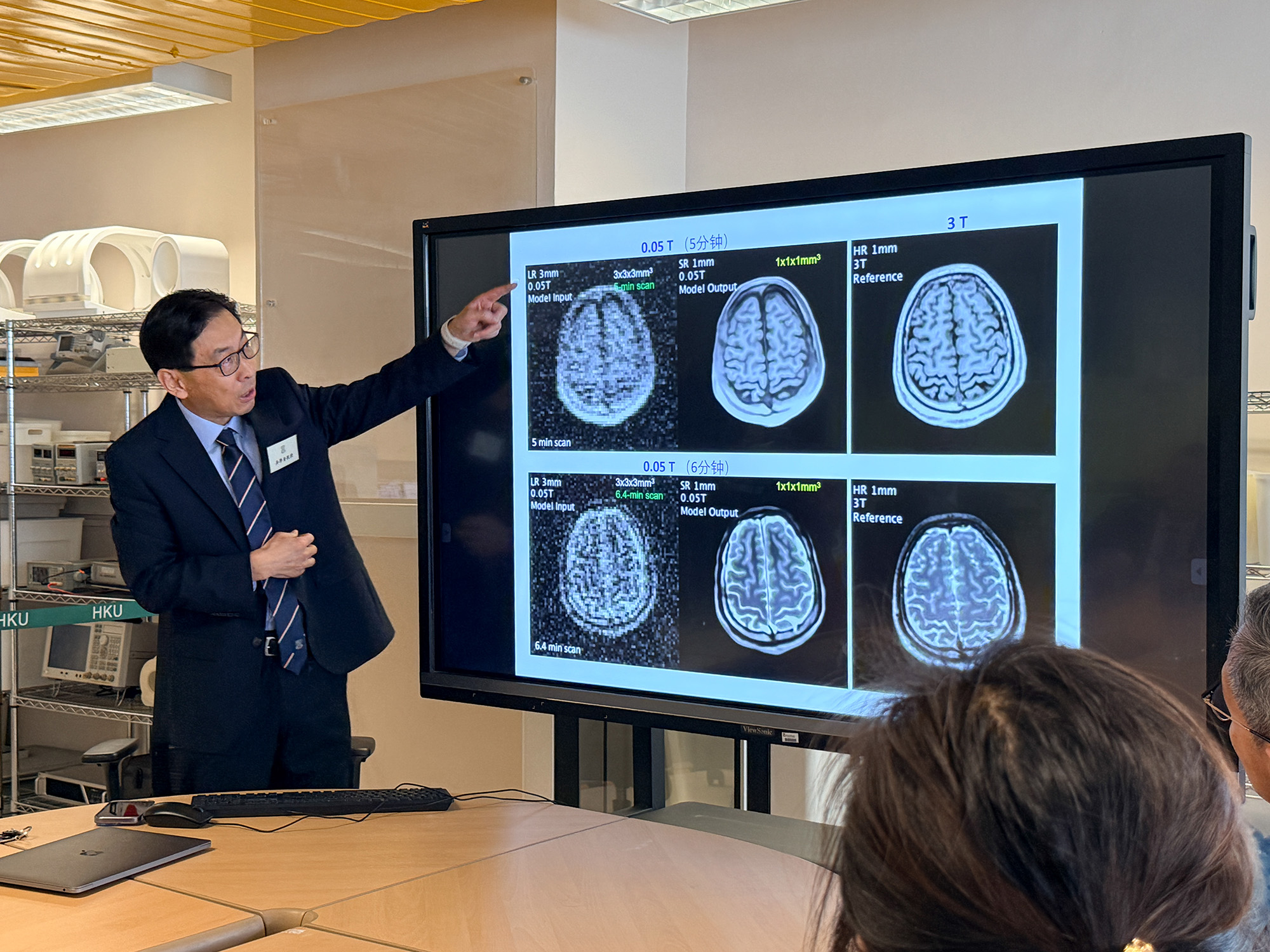
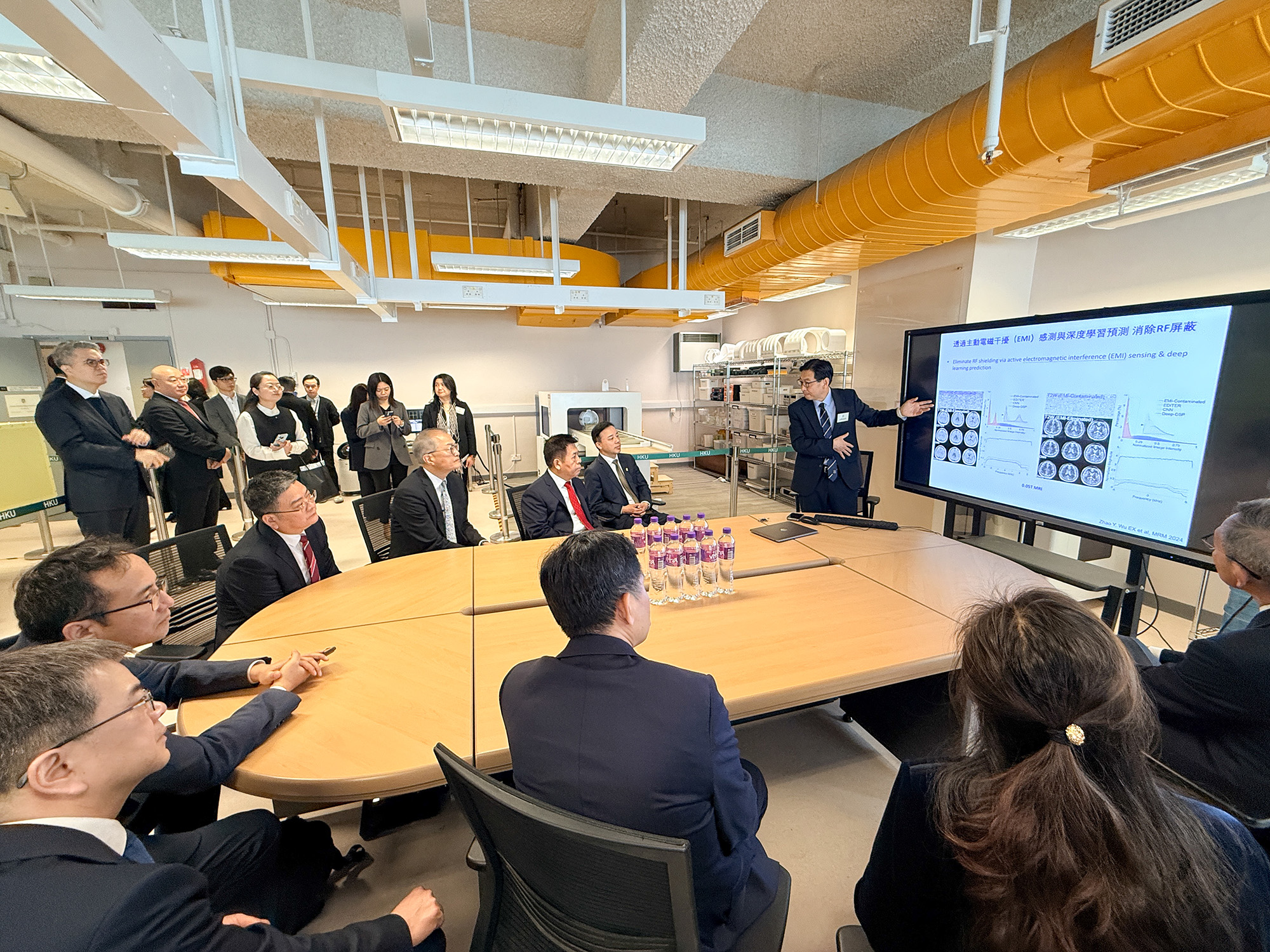
During the lab visit, Prof. WU introduced and demonstrated a groundbreaking ultra-low-field magnetic resonance imaging (MRI) technology. This technology aims to develop low-cost, low-power, compact, and computing-powered ultra-low-field MRI scanners. It seeks to overcome the barriers of high cost, as well as stringent infrastructure and maintenance requirements associated with existing clinical high-field MRI scanners, paving the way for affordable, patient-centric, and deep learning-powered ULF MRI scanners, and addressing unmet clinical needs in diverse healthcare settings worldwide.
The detailed research findings on this technology have been published in Science, titled “Whole-body magnetic resonance imaging at 0.05 Tesla”, with commentary articles in Science, Nature Medicine, IEEE Spectrum, and Physics Today. Prof. Wu’s team developed a highly simplified whole-body ultra-low-field (ULF) MRI scanner that operates on a standard wall power outlet without RF or magnetic shielding cages. This scanner uses a compact 0.05 Tesla permanent magnet and incorporates active sensing and deep learning to address electromagnetic interference (EMI) signals. To enhance image quality and reduce scan time, the team also developed a data-driven deep learning image formation method, which integrates image reconstruction and three-dimensional (3D) multiscale super-resolution and leverages the homogeneous human anatomy and image contrasts available in large-scale, high-field, high-resolution MRI data.
Dr. Haichao LEI commended HKU’s contributions in talent attraction and cultivation, basic research, and internationalisation. He also lauded the University’s achievements in translating innovative healthcare technologies into practical applications. He emphasised the importance of strengthening collaboration between Hong Kong and Chinese Mainland in healthcare, as well as underscoring the value of global partnerships in advancing health technology innovation.
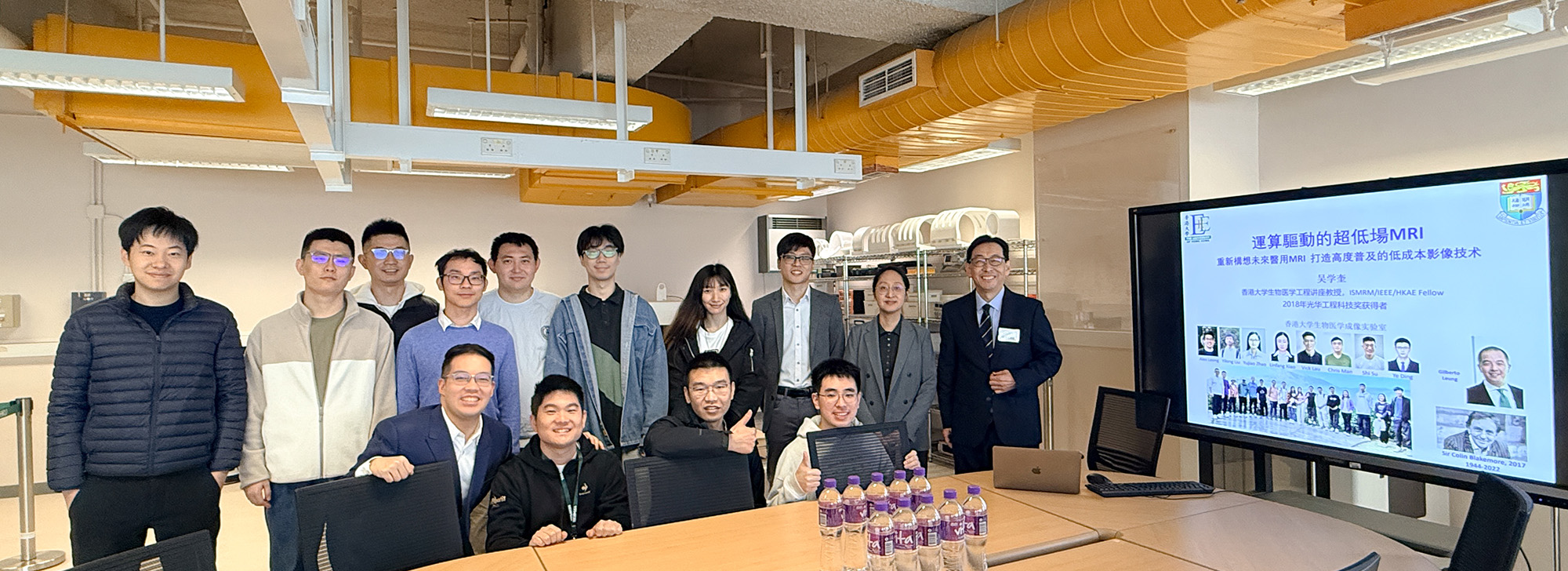
As a significant interdisciplinary research and exchange activity, we sincerely thank the faculty members, researchers and technical staff from the department and laboratory for their active participation and valuable contributions. This visit not only strengthens collaboration between the department and the national research community but also lays a solid foundation for future partnerships in medical innovation and research. The department remains committed to advancing cutting-edge technologies and applying innovative solutions to advance global healthcare development.
Source
- HKU Official Press Release: https://www.hku.hk/press/press-releases/detail/28893.html
- HKU Biomedical Imaging Laboratory website: https://www4.hku.hk/bisplab
(Chinese version)
國家衞生健康委員會(國家衞健委)主任雷海潮博士於2026年1月13日率代表團訪問香港大學(港大)。代表團成員包括國家衞健委、中央港澳工作辦公室(中央港澳辦)及國務院港澳事務辦公室(國務院港澳辦)的代表,並由香港特別行政區政府醫務衞生局局長盧寵茂教授陪同。代表團與港大校務委員會主席王冬勝博士、校長張翔教授、副校長(健康)劉澤星教授、協理副校長(中國事務)黃依倩女士和香港大學深圳醫院院長張文智教授等會面。
訪問期間,代表團參觀了香港大學電機電子工程系生物醫學影像實驗室(BISP Lab)。該實驗室由電機電子工程系與李嘉誠醫學院聯合成立的跨學科研究實驗室,旨在探討正常、病變及神經系統疾病中解剖結構、生理功能與神經功能之間的相互關係。該實驗室由香港大學工程學院電機電子工程系吳學奎教授帶領,致力於開發並應用尖端影像技術與計算方法,針對多種動物模型及人體進行解剖結構、生理功能與神經功能研究。同時,實驗室亦透過工程創新與計算技術,研發先進磁共振成像技術以推動普惠醫療發展。
本次實驗室參觀由吳教授介紹並展示了一項有突破性的超低場磁共振成像(MRI)技術。這項技術旨在開發具有低成本、低功耗、且運算能力強的超低場MRI掃描儀,突破傳統臨床高場MRI在成本、基礎設施需求和維護方面的高門檻限制。此創新技術為實現更為經濟、以病人為本的超低場MRI系統鋪平了道路,並結合深度學習,有效滿足全球多元醫療環境中尚未被充分解決的臨床需求。
最新的研究成果已發表於《科學》雜誌,題為《0.05 Tesla超低場全身磁力共振影像》,相關文章亦刊登在《科學》、《自然醫學》、《科技縱覽》及《今日物理學》等權威期刊。吳教授團隊成功開發了一款極簡化的全身超低場(ULF)磁力共振(MRI)掃描儀,該設備可接駁標準牆身插座的電源運行,無需射頻或磁場屏蔽技術便可使。這款掃描儀採用小型0.05Tesla超低磁場強度永久磁鐵,結合主動感測和深度學習來處理電磁干擾 (EMI) 訊號。此外,團隊還研發了一種數據驅動的深度學習成像方法,將影像重建與三維(3D)多尺度超解析度技術相結合,充分利用大規模高場高解析度MRI資料中的人體解剖結構和對比資訊,以提升成像品質並縮短掃描時間。
雷海潮博士讚揚港大在人才培育、基礎科研及國際化發展方面的卓越貢獻。雷博士同時表揚大學在創新醫療科技研發及應用方面取得的實效成果。他指出,深化香港與內地醫療衞生合作具有重要意義,並強調加強全球合作將有助推動健康科技創新發展。
作為本系重要的跨學科研究訪問交流活動,我們感謝來自部門與實驗室的教職員、研究人員及技術人員的積極參與和貢獻。本次訪問不僅促進了本校與國家交流,更為未來在醫療創新科研領域的合作奠定了堅實的基礎。本系將持續致力於推動前沿科技的研發與應用,為全球醫療健康事業作出貢獻。
來源
- 香港大學新聞稿:https://www.hku.hk/press/press-releases/detail/c_28893.html
- 香港大學生物醫學成像實驗室網站:https://www4.hku.hk/bisplab