
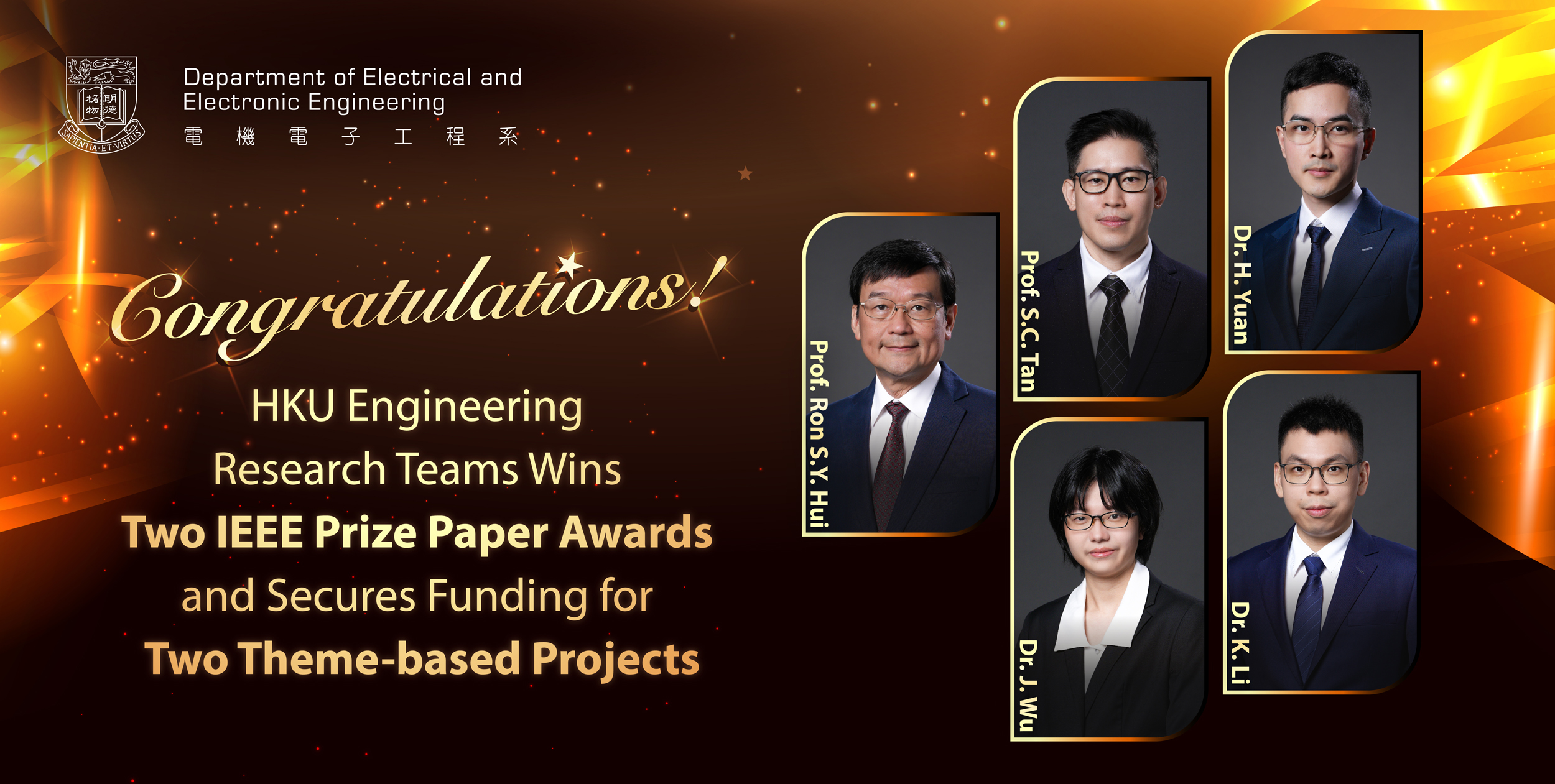
Each year, the Editorial Boards of the IEEE Transactions on Power Electronics (TPEL) and IEEE Journal of Emerging and Selected Topics in Power Electronics (JESTPE) recognize papers that are deemed best among those published in the TPEL/ JESTPE during the preceding calendar year. We are delighted to announce the remarkable achievement of the HKU engineering research teams, who won two IEEE Prize Paper Awards for 2023 from two Tier-1 IEEE Research Journals. These two journals are the premium research journals in Power Electronics, with only the top 0.5% of journal papers selected by the Editorial Boards.
The two IEEE Prize Paper Awards are:
(1). IEEE Prize Paper Award from the IEEE Transactions on Power Electronics
A distinguished HKU engineering research team led by Prof. Shu-Yuen Ron Hui of the HKU Department of Electrical and Electronic Engineering, and co-authored by Dr. Kerui Li (HKU), Dr. Jiayang Wu (HKU) and Prof. Abdulkadir C. Yucel of the School of Electrical & Electronic Engineering at the Nanyang Technological University, won the IEEE Prize Paper Award from the IEEE Transactions on Power Electronics (TPEL) for their paper titled “New Printed-Circuit-Board Resonators with High Quality Factor and Transmission Efficiency for Mega-Hertz Wireless Power Transfer Applications”, published in 2023 (IEEE Trans. Power Electron., Vol. 38. Issue 10, pp. 13207-13218).
(2). IEEE Prize Paper Award from the IEEE Journal of Emerging and Selected Topics in Power Electronics
Another exceptional HKU engineering research team, under the leadership of Prof. Shu-Yuen Ron Hui and co-authored by Dr. Yun Yang (Nanyang Technological University) and Dr. Cheng Zhang (University of Manchester, U.K.), won the IEEE Prize Paper Award from the IEEE Journal of Emerging and Selected Topics in Power Electronics (JESTPE) for their paper titled “Wireless Power Transfer: A Paradigm Shift for The Next Generation”, published in 2023 (IEEE JESTPE, Vol. 11, No. 3, pp. 2412-2427).
The University Grants Committee (UGC) has announced the funding results of the Theme-based Research Scheme (TRS) and the Innovation and Technology Support Programme (ITSP) for 2024/25. The HKU engineering research teams achieved outstanding results leading two projects, securing a total funding of about HKD$35 million in external competitive research grants.
The two HKU-led projects are:
(1). Research Grants Council (RGC) Theme-based Scheme Project of HKD$28.2 million
TRS aims to focus academic research efforts of UGC-funded universities on themes of strategic importance to the long-term development of Hong Kong. The HKU engineering research team led by Prof. Shu-Yuen (Project Coordinator) Ron Hui and Prof. Siew Chong Tan (Co-Principal Investigator) from the HKU Department of Electrical and Electronic Engineering, won an RGC theme-based scheme project titled “High-frequency, high-power and high-efficiency wireless power transfer technologies”. This project breaks into the uncharted territory of wireless power transfer (WPT) technologies. It will greatly improve the WPT for the next generation and has the potential for adoption in emerging and future international wireless standards for a wide range of applications such as mobile electronics, robots, notebook computers, e-bikes, drones, medical implants and electric vehicles.
(2). Innovation and Technology Support Programme (ITSP) Theme-based Research Project of HKD$5.2 million
ITSP encourage universities to collaborate with leading research institutes worldwide to conduct more theme-based inter-disciplinary and translational research and development (R&D) work in focused technology areas. The HKU engineering research team led by Prof. Shu-Yuen (Project Coordinator) Ron Hui and Dr. Huawei Yuan (Co-Principal Investigator) from the HKU Department of Electrical and Electronic Engineering, won an ITSP theme-based research project titled “Electric-Spring Enabled Solid-State Transformers for Stabilizing Power Grid with Near Net-Zero Electricity”. This project studies practical solutions to combat climate change through drastic reduction of fossil-fuel based electricity generation. The project will study the combined use of (i) a new generation of “electric springs” distributed in the power network and (ii) the emerging large-scale EV charging infrastructure, for absorbing the power fluctuations arising from the large-scale wind and solar energy generation. The combined use of Electric Springs and EV charging infrastructures will form a highly robust stabilizing system to allow power grid to maximize its renewable energy penetration so that the batteries in EVs can interact seamlessly with the AC power system fed by renewables.
The team also won two General Research Grants (GRF) totalling HKD$1.5 million.
Congratulations to the HKU engineering research teams on their outstanding achievements! These successes further enhance the University’s global reputation as a top-tier research institution, fostering a culture of innovation and excellence.