
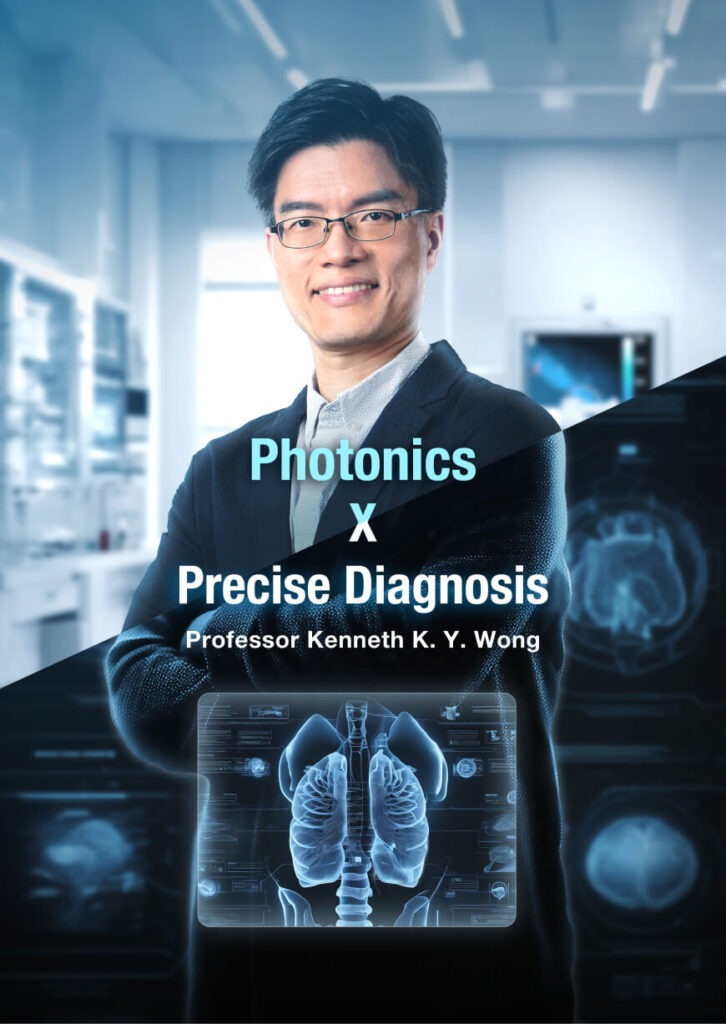
Professor Kenneth K.Y. Wong
Head and Professor from Department of Electrical and Electronic Engineering
Inventor of compact fibre laser microscope
Research Area: Photonics
Research Highlight
Professor Kenneth K. Y. Wong has been leading the development of ultra-deep and ultra-fast optical microscopies and laser technologies to produce images of brain tissues and, ultimately, deepen understanding of fundamental neuroscience and the mechanisms behind psychiatric diseases. One achievement is a compact fiber laser microscope that bypasses fluorescent markers to obtain a clear image of cell molecules and uses a fiber laser as the light source to replace the traditional solid-state laser. Its compactness makes it highly suitable for clinical applications, such as in endoscopic examinations of the intestines and digestive systems to detect tumours and lesions. Professor Wong and his collaborators are also developing an integrated and modularised multiphoton microscopy that could rapidly capture deep and functional animal brain imaging.
Professor Wong’s research interests include novel optical generation, photonic parametric processing and ultra-fast optical fibre communication and imaging (spectroscopy, microscopy and tomography). He has a PhD from Stanford University and was a member of the Photonics and Networking Research Laboratory there. He also has industry experience with organisations such as Hewlett Packard Laboratories and Innovation CORE (A Sumitomo Electric Company).
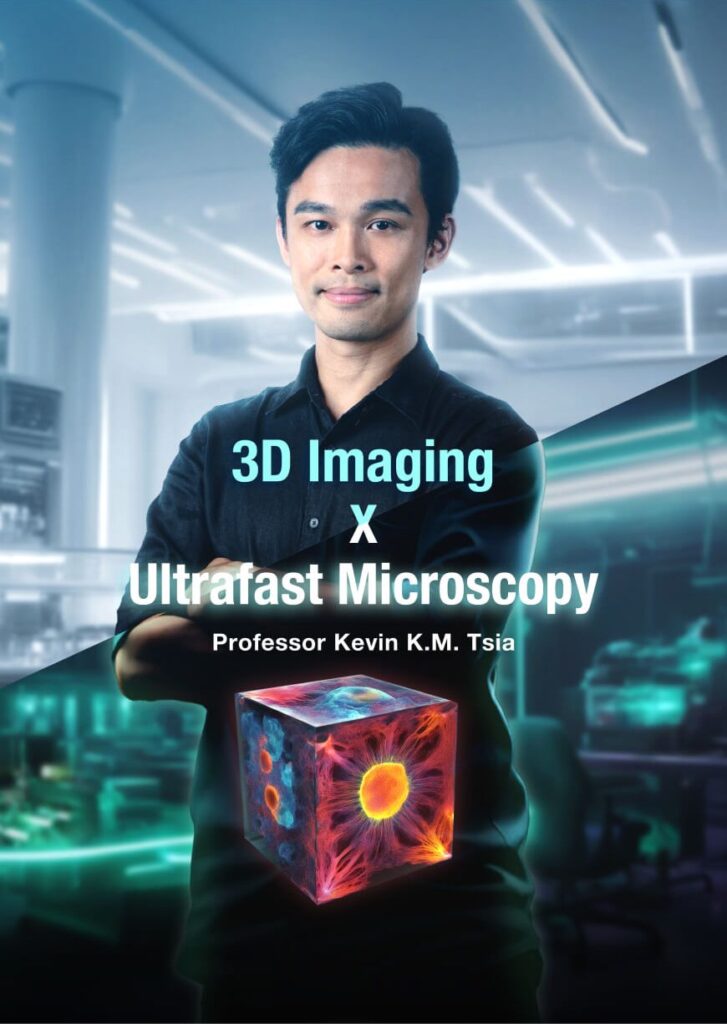
Professor Kevin K.M. Tsia
Programme Director of Biomedical Engineering Programme
Department of Electrical and Electronic Engineering
Inventor of optical imaging technology CLAM [coded light-sheet array microscopy]
Research Area: 3D imaging
Research Highlight
Professor Kevin K.M. Tsia has developed brain imaging technology that can penetrate the brain more deeply than other gold-standard technologies and capture images of individual blood cells in fast motion. Brain activity is fueled by energy from blood cells and the technology was able to show how red blood cells moved around in the brains of animals that were awake and able to move somewhat. The tool will help neuroscientists better understand the inner workings of the brain, in particular how energy is distributed and regulated in both healthy and diseased minds.
The discovery emerged from Professor Tsia’s ongoing work on ultra-fast optical imaging for flow cytometry and cell-based assay high-speed in-vivo brain imaging approaches to analyse single cells, which have been widely covered by media and scientific magazines. He holds several US patents on his technologies and has co-founded a startup company to commercialise high-speed microscopy to screen for cancer and monitor treatment. Professor Tsia received his PhD from the University of California Los Angeles and he is currently a Research Fellow of the Hong Kong Research Grants Council (RGC).