
Professor Zhiqin CHU of the Department of Electrical and Computer Engineering and Professor Yuan LIN of the Department of Mechanical Engineering co-led the research on “Uncovering piezoelectric effect in polycrystalline diamond membranes”. The research findings were published in Science Advances on March 18, 2026.


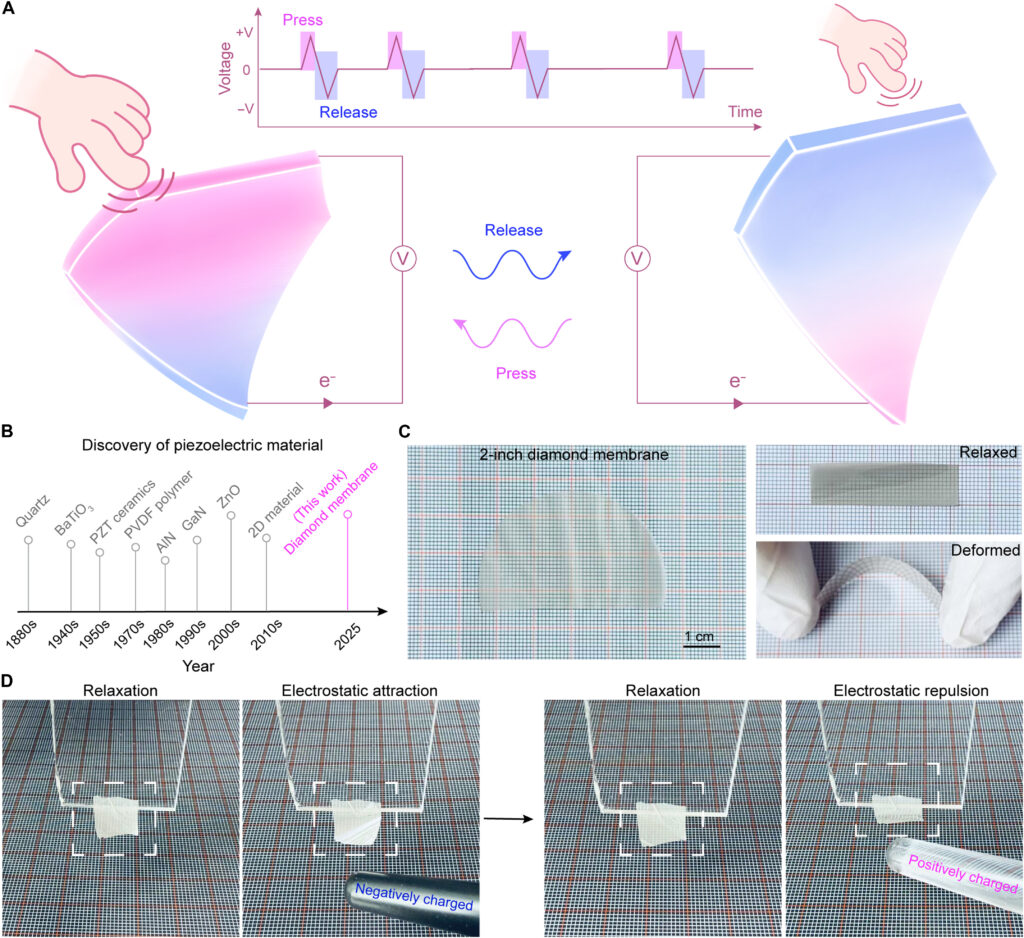
Details of the publication:
Uncovering piezoelectric effect in polycrystalline diamond membranes
Jixiang Jing, Bicong Wang, Yumeng Luo, Yicheng Wang, Zhongqiang Wang, Yiyao Liu, Dong‑Keun Ki, Xinghua Shi, Qi Wang, Kwai Hei Li*, Yuan Lin*, and Zhiqin Chu*.
Article in Science Advances
https://www.science.org/doi/full/10.1126/sciadv.aea8318
Abstract
Diamonds have been regarded as nonpiezoelectric materials for more than one century. Here, we uncover a notable piezoelectric effect in ultrathin and ultraflexible polycrystalline diamond membranes. Our experiments show that the piezoelectricity depends on membrane thickness, with peak response (exhibiting a piezoelectric voltage coefficient of ~82.2 millivolt meters per newton that surpasses many conventional piezoelectric materials) seen in ~5-micrometer-thick membranes. First-principles calculations reveal that the unexpected piezoelectricity in polycrystalline membranes originates from local asymmetry induced by grain boundaries, which alter the electric polarization within a finite region near the boundary during deformation. This finding together with the outstanding properties of our membranes is expected to catalyze the exploration and development of diamond-based applications in energy harvesting, intelligent sensing, and wearable electronics.