
Professor Shiming ZHANG, Professor Xiaojuan QI, and Professor Han WANG of the Department of Electrical and Computer Engineering, together with their teams and collaborators from multiple institutions, conducted the research “Pruning random resistive memory for optimizing analog AI.” The findings were published in Nature Communications on January 10, 2026.

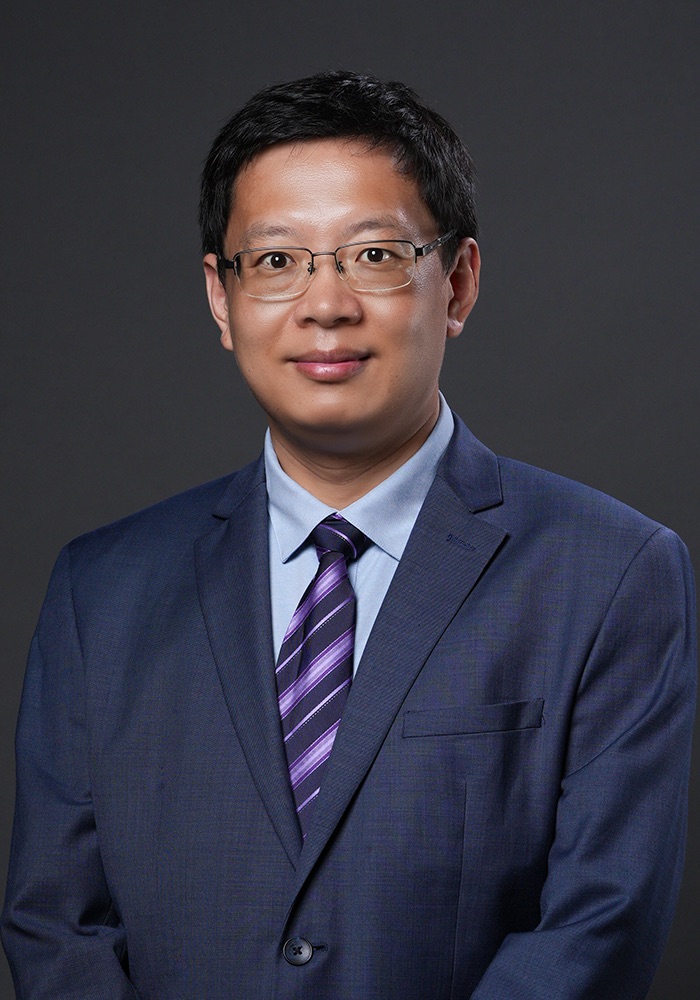
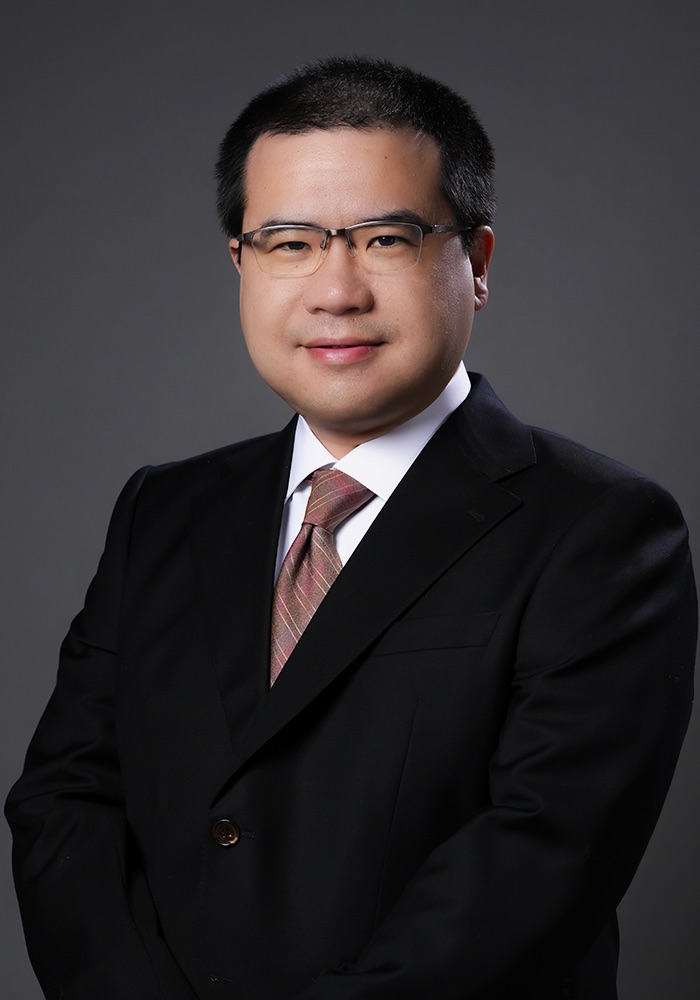
Details of the publication:
Pruning random resistive memory for optimizing analog AI
Yi Li, Songqi Wang, Yaping Zhao, Shaocong Wang, Bo Wang, Woyu Zhang, Yangu He, Ning Lin, Binbin Cui, Xi Chen, Shiming Zhang, Hao Jiang, Peng Lin, Xumeng Zhang, Feng Zhang, Xiaojuan Qi, Zhongrui Wang, Xiaoxin Xu, Dashan Shang, Qi Liu, Han Wang, Kwang‑Ting Cheng & Ming Liu
Article in Nature Communications
https://www.nature.com/articles/s41467-025-67960-6
Abstract
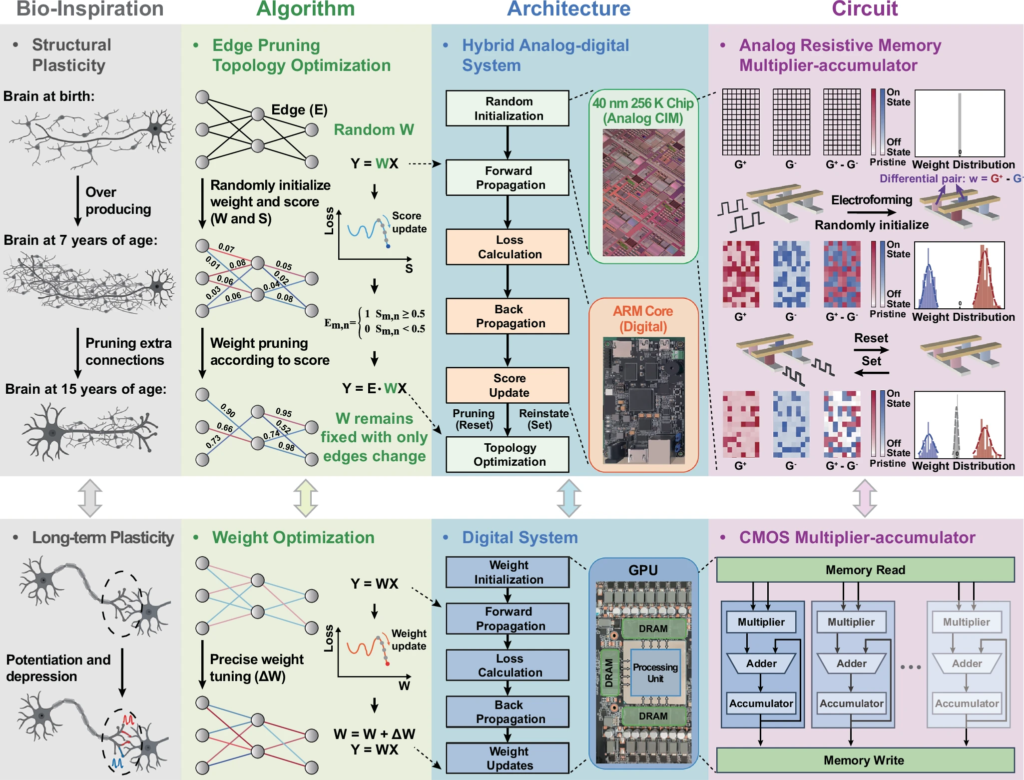
The rapid expansion of AI models has intensified concerns over energy consumption. Analog in-memory computing with resistive memory offers a promising, energy-efficient alternative, yet its practical deployment is hindered by programming challenges and device non-idealities. Here, we propose a software-hardware co-design that trains randomly weighted resistive-memory neural networks via edge-pruning topology optimization. Software-wise, we tailor the network topology to extract high-performing sub-networks without precise weight tuning, enhancing robustness to device variations and reducing programming overhead. Hardware-wise, we harness the intrinsic stochasticity of resistive-memory electroforming to generate large-scale, low-cost random weights. Implemented on a 40 nm resistive memory chip, our co-design yields accuracy improvements of 17.3% and 19.9% on Fashion-MNIST and Spoken Digit, respectively, and a 9.8% precision-recall AUC improvement on DRIVE, while reducing energy consumption by 78.3%, 67.9%, and 99.7%. We further demonstrate broad applicability across analog memory technologies and scalability to ResNet-50 on ImageNet-100.