
An engineering research team from the Department of Electrical and Computer Engineering and Centre for Advanced Semiconductors and Integrated Circuits (CASIC) at The University of Hong Kong, led by Professor Yuhao ZHANG, in collaboration with Professor Guo-Quan LU (Virginia Tech) and Professor Jiandong YE (Nanjing University), has achieved a breakthrough in ultrawide-bandgap (UWBG) semiconductor-based power electronics. The team demonstrated a megawatt-class gallium oxide (Ga2O3) power module capable of continuous pulsed switching at 1000 V and 1000 A, enhancing the power capacity of UWBG power electronics by over two orders of magnitude and achieving improvement over the silicon and wide-bandgap counterpart. The work, titled “A megawatt ultra-wide bandgap semiconductor module for pulsed power electronics”, is published in Nature Communications.
Power semiconductor devices underpin modern energy systems such as data centers, electric vehicles, and power grids. While WBG semiconductor technologies have significantly advanced power electronics, UWBG materials like Ga2O3 offer even higher theoretical limits. However, their practical power capability has remained at the kilowatt level for a decade due to material and device non-uniformities and challenges in packaging. To address this, the team developed a device-package co-optimization strategy for UWBG materials targeting novel pulsed power electronics in healthcare, grid, and fusion applications, where devices must handle extreme voltage and current within microsecond timescales. This application best leverages the Ga2O3’s unique properties including high volumetric heat capacity and thermal stability, as the transient heating in such pulsed power systems is dominated by volumetric heat capacity.
Researchers have unveiled a transformative junction-side cooling architecture integrated with a high-permittivity interface, breaking previous performance limits for Ga2O3 electronics. By leveraging the polarization effect of high-permittivity layers, the team successfully redistributed electric fields, simultaneously boosting breakdown voltages and slashing thermal resistance.
In a landmark demonstration, a single submodule sustained pulsed currents of 234 A at 1 kV, enduring extreme junction temperatures above 250°C. Scaling this innovation, the team developed a six-die integrated module capable of continuous 1000 V / 1000 A switching at 1 kHz—marking the first-ever UWBG multi-chip module to reach megawatt-level power capacity. With ultra-fast switching (~23 ns) and near-zero reverse recovery, this device-package co-design provides a clear, scalable roadmap for the future of high-power, high-efficiency energy systems.
This research builds on the group’s prior work in electro-thermo-mechanical device-package co-design, which has received significant traction. A previous iteration of this multi-physics approach was selected as a Technical Highlight at the 2025 IEEE International Electron Devices Meeting (IEDM)—the premier global conference for semiconductor devices. This distinction is reserved for the top 1.5% of all submissions.
The international impact of the work was further highlighted by Nature Electronics in a News & Views commentary titled ‘Powering the ultrawide-bandgap era’ written by Professor Savannah Eisner of Columbia University. This article discussed the team’s strategy of multi-physics optimization strategies for power devices and modules. These honors reflect the laboratory’s role in developing the robust device-package architectures necessary for the next generation of power electronics
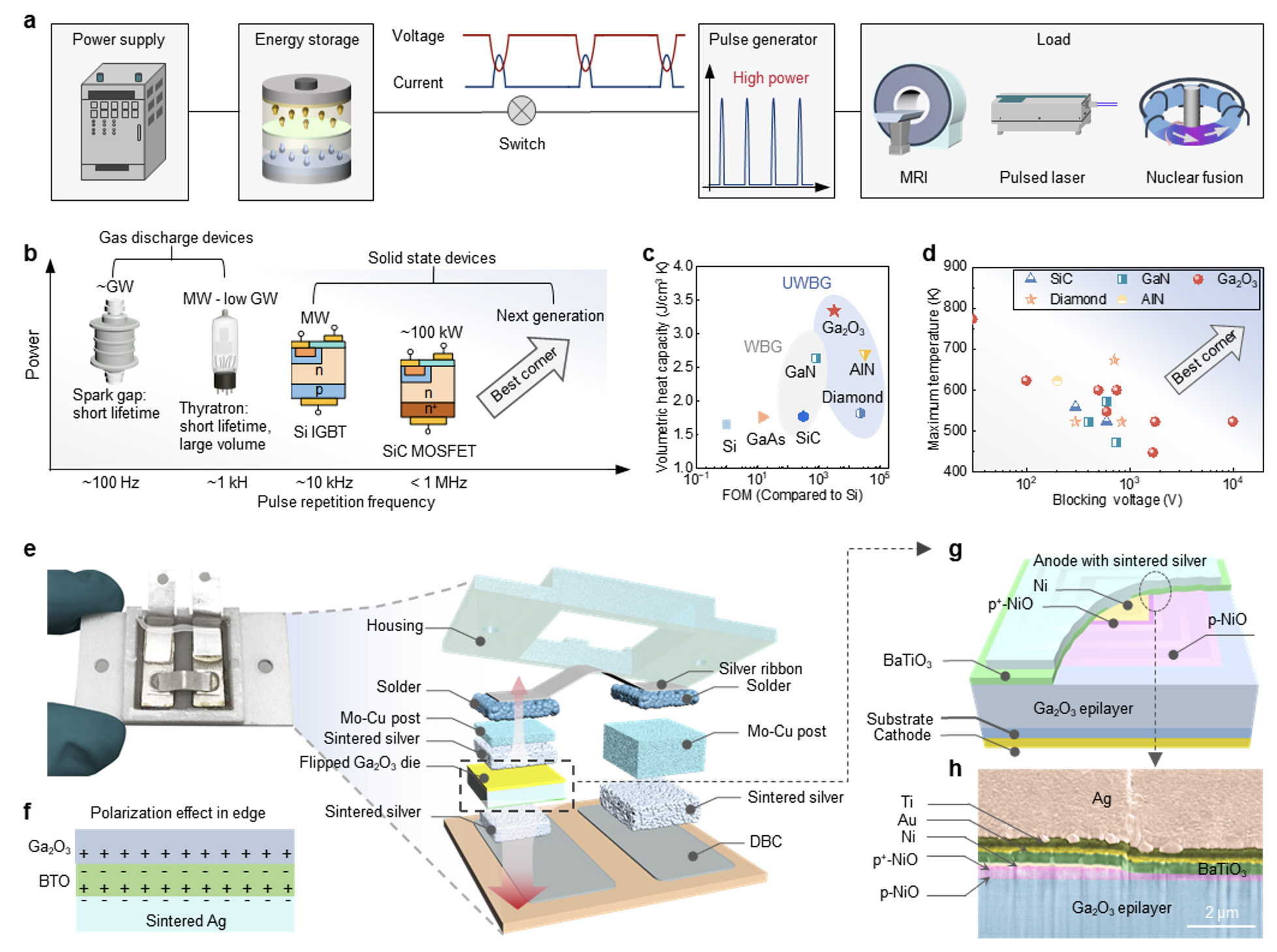
^Figure 1: Pulsed power applications, material selection, as well as device and package designs.
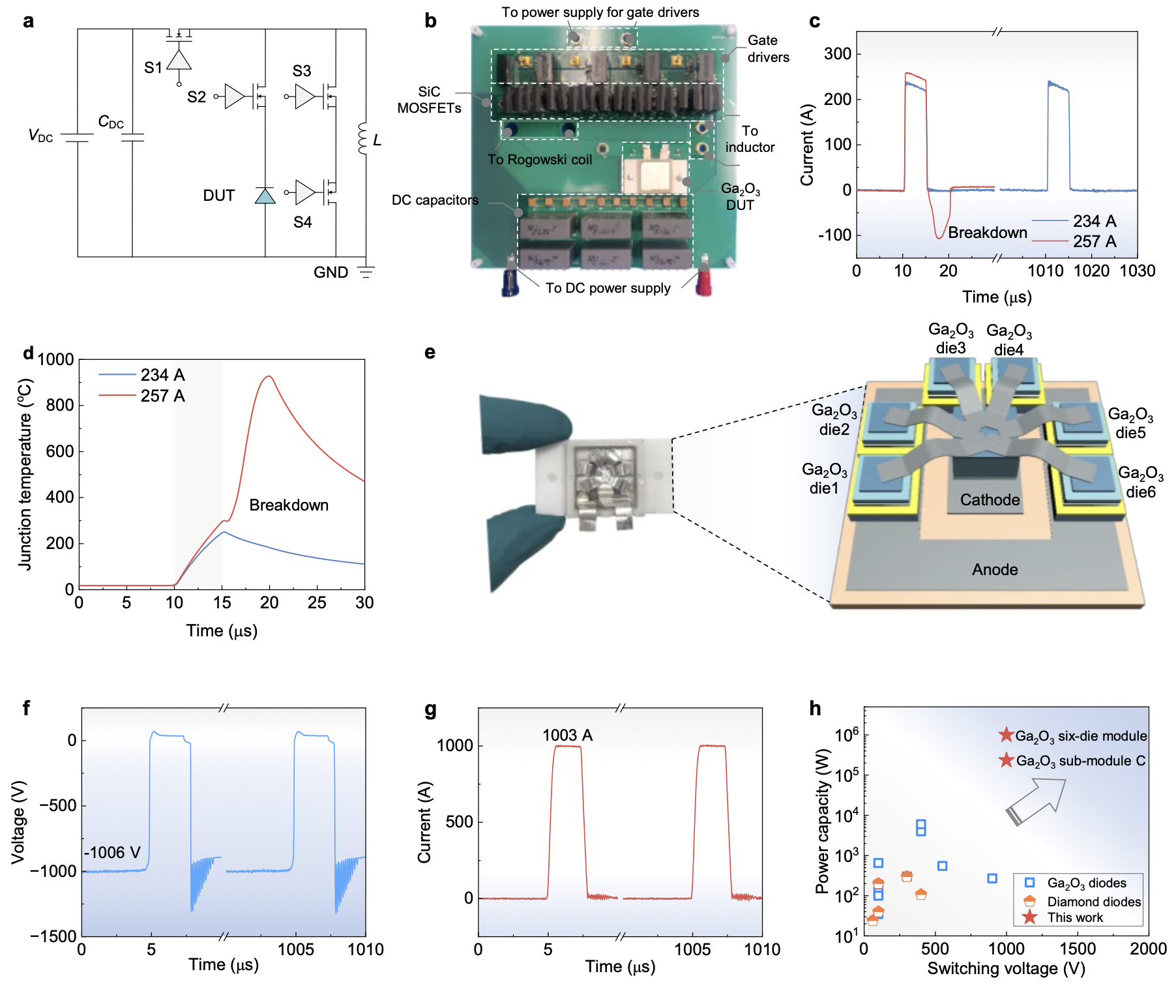
^Figure 2: Demonstration of megawatt pulsed power switching in practical power converter.



- Link to the Nature Communications paper: https://www.nature.com/articles/s41467-026-71274-6
Hehe Gong#, Xin Yang#, Bo Wang, et al. A megawatt ultra-wide bandgap semiconductor module for pulsed power electronics. Nature Communications (2026). DOI: 10.1038/s41467-026-71274-6
- Link to the IEDM paper: https://ieeexplore.ieee.org/abstract/document/11353633
Hehe Gong#, Xin Yang#, Bo Wang, et al. First Demonstration of an Ultra-Wide Bandgap Power Module through Device-Package, Electro-Thermo-Mechanical Co-Optimization. 2025 IEEE International Electron Devices Meeting (IEDM). DOI: 10.1109/IEDM50572.2025.11353633
- Link to the News & Views commentary by Nature Electronics: https://www.nature.com/articles/s41928-025-01520-0
Savannah Eisner. Powering the ultrawide-bandgap era. Nature Electronics (2025). DOI: https://doi.org/10.1038/s41928-025-01520-0
- Wide Bandgap Electronics Group Team webiste: https://widebandgap.github.io