
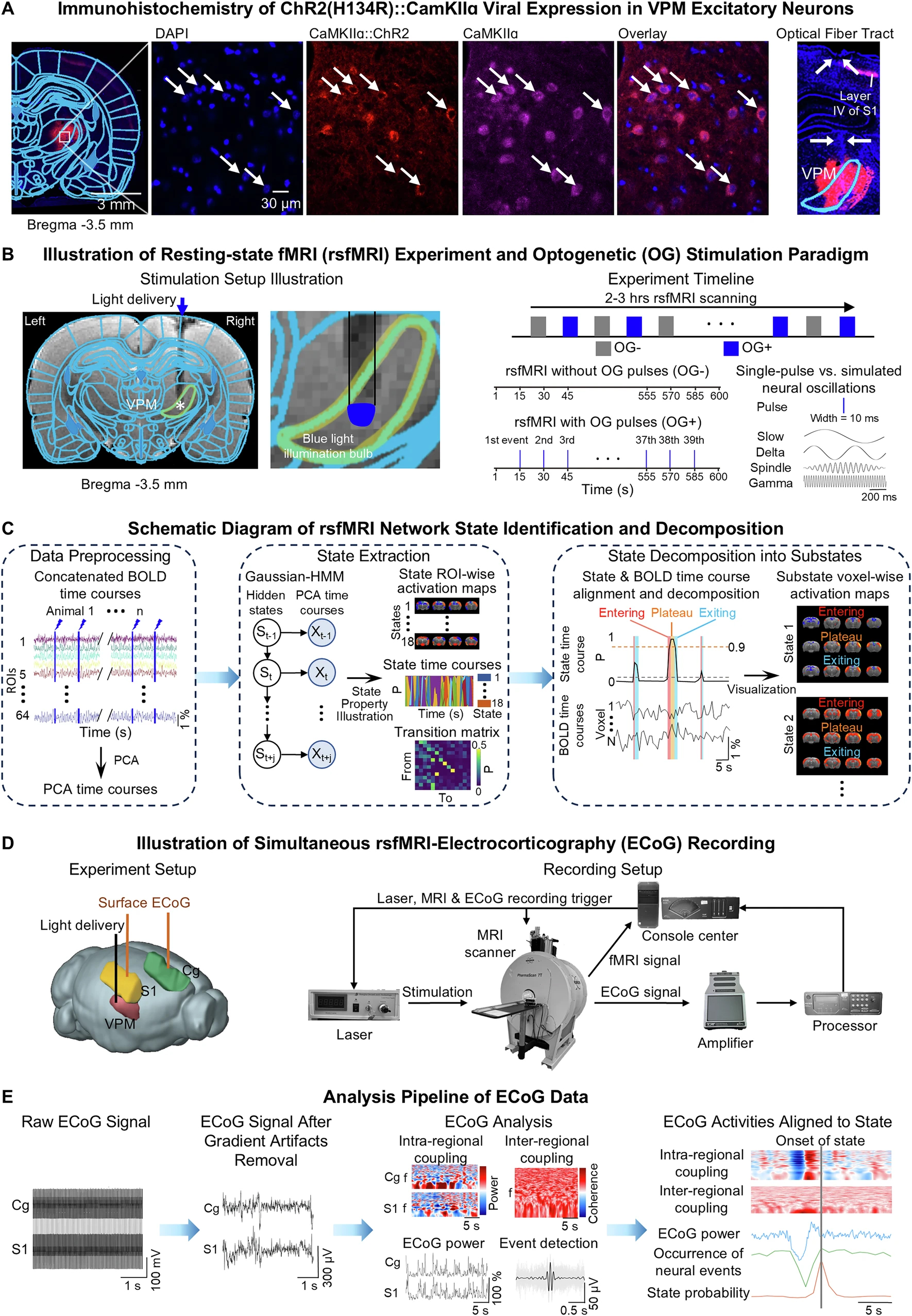
Professor Ed X. WU from the Department of Electrical and Computer Engineering and his team, worked on the research for the topic “Brain-wide resting-state fMRI network dynamics elicited by activation of single thalamic input”. The research findings were published in Nature Communications on December 17, 2025.
Details of the publication:
“Brain-wide resting-state fMRI network dynamics elicited by activation of single thalamic input”
Linshan Xie, Xunda Wang, Xuehong Lin, Junjian Wen, Teng Ma, Alex T. L. Leong & Ed X. Wu
Link to the Article in Nature Communications: https://www.nature.com/articles/s41467-025-66104-0
Abstract
Understanding how the brain rapidly processes neural information through large-scale network dynamics is fundamental to neuroscience. Resting-state fMRI (rsfMRI) captures networks by probing spontaneous neural activity fluctuations, yet whether these networks can accommodate fast, sensitive information processing remains unknown. Here, we reveal brain-wide rsfMRI network dynamics (i.e., states and their transitions) that enable fast information processing through rapid activity-triggered network reconfiguration in male rats. Following activation of a single optogenetically evoked somatosensory thalamic input, states and transitions associated with internally-oriented information processing are quickly suppressed and diverted through basal forebrain and hypothalamus to strengthen externally-oriented (i.e., sensory) processes. Simultaneous rsfMRI and electrophysiology measurements in somatosensory and cingulate cortices demonstrate that intra-regional wide-band and inter-regional narrow-band (i.e., slow-oscillations) neural activity synchronizations directly drive rsfMRI network dynamics and reconfiguration to support fast processing of single thalamic input. Our study uncovers fast interactions between neural activity and rsfMRI networks in processing single neural input.