
Professor Kenneth K. Y. WONG and Professor Kevin K. TSIA from the Department of Electrical and Computer Engineering and their team, along with collaborators from other universities, worked on the research for the topic “Multiplane compressive imaging with axial-coded multiphoton microscopy”. The research findings were published in Advanced Photonics on July 16, 2025.


Details of the publication:
Multiplane compressive imaging with axial-coded multiphoton microscopy
Xin Dong, Hongsen He, Minghui Shi, Cora S. W. Lai, Kevin K. Tsia, and Kenneth K. Y. Wong
Link to the article in Advanced Photonics: https://www.spiedigitallibrary.org/journals/advanced-photonics/volume-7/issue-04/046010/Multiplane-compressive-imaging-with-axial-coded-multiphoton-microscopy/10.1117/1.AP.7.4.046010.full
Abstract
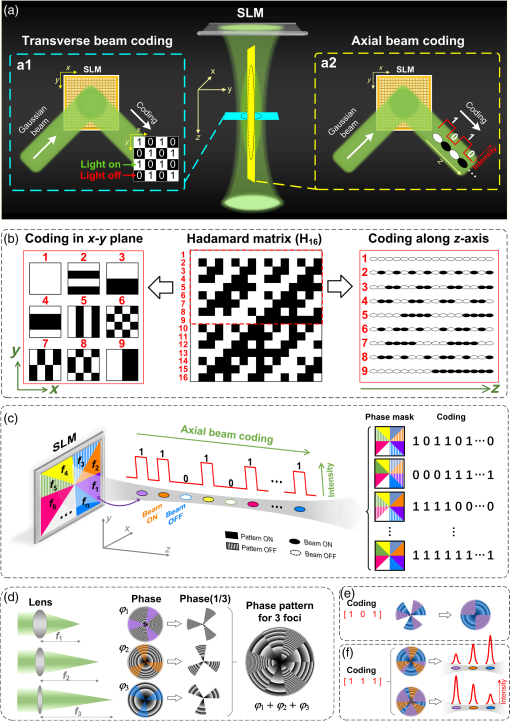
The slow axial scanning rate in multiphoton microscopy (MPM) has traditionally limited the speed of three-dimensional (3D) imaging. Recently, a lot of techniques have been proposed to speed up the axial scan; however, there inherently exists an upper limit of the achievable maximum scanning rate restricted by full sampling. To overcome this limitation, we developed an approach to realize multiplane compressive imaging in MPM that empowers conventional laser scanning microscopies with rapid axial scanning capacity in a sub-sampling way. To realize the technique, we achieved two technical breakthroughs: first, we proposed a concept to axially encode the beam with binary intensities; second, compressive sensing theory was introduced to the axial direction in MPM based on the axial-coded point spread function. This 3D imaging technology is termed arbitrary illumination microscopy with encoded depth (AIMED), enabling a nearly double volumetric imaging speed with subcellular resolution for mouse brain neurons in experiments and performing approximately eight times faster in simulation. The axial compressive ability of AIMED can be readily extended to other microscopic modalities for achieving axially compressive 3D imaging. Our concepts demonstrated provide insights into the entire field of advanced volumetric microscopy.